- On Student Success
- Posts
- Reinventing the Wheel, Again
Reinventing the Wheel, Again
The recurring blind spot in EdTech’s promises of frictionless scale

Glenda Morgan
April 16, 2026

Was this forwarded to you by a friend? Sign up for the On Student Success newsletter and get your own copy of the news that matters sent to your inbox every week.
EdTech has a recurring habit of announcing the next transformative breakthrough with enormous fanfare and little introspection. A new technology. A new model. A new price point that promises to reshape higher education, reduce costs, and finally achieve scale.
Often, these innovations are not entirely new. They are familiar ideas repackaged with updated language and some contemporary technology. But they tend to rest on a persistent set of misunderstandings — about how students actually engage, how learning unfolds, and how difficult scale really is.
The recent sequence of events involving Sal Khan offers a particularly instructive example. First came the quiet recalibration around Khanmigo, the AI tutoring tool that was initially framed as transformative but appears to have seen limited sustained use. Almost immediately afterward came the announcement of a new joint venture with ETS and TED to launch a low-cost online degree. The new venture was touted as.
[snip] a new higher education collaboration designed for an AI‑driven era. [snip][which] aims to prepare learners for the next generation of jobs while cultivating the uniquely human skills required to thrive in work, life, and society amid rapid technological change.
Individually, neither development is remarkable. But together, they illustrate something more revealing: the rapid pivot from one ambitious claim to another, without fully reckoning with the structural constraints that limited the first.
The 5% problem
The first signal of this latest cycle was the Chalkbeat article revisiting the performance of Khanmigo, Khan Academy’s AI tutoring tool. In it, Sal Khan appeared to temper some of his earlier claims about how transformative AI tutoring would be. The article noted that student uptake had been limited and that sustained usage was concentrated among a relatively small subset of students.
The piece quickly spawned a familiar secondary wave of commentary. But the most interesting detail in the article was a familiar one. Only a small fraction of students regularly used Khanmigo; roughly 5 percent in some implementations.
Khan and other company representatives expressed frustration at students’ lack of engagement. The students weren’t using it “correctly.” They weren’t self-initiating.
This is where the pattern reasserts itself.
When only 5 percent of students engage with a voluntary educational tool, that is not primarily a student problem. It is a design and integration problem. The hardest challenge in EdTech is not building a capable tool. It is embedding that tool into systems that support motivation, accountability, and sustained use — especially for students who are juggling many demands and uneven academic preparation.
Teaching the already motivated 5 percent is not transformation. It is amplification. Which makes the rapid pivot — from limited engagement with an AI tutor to the announcement of a fully AI-mediated, $10,000 degree — especially striking.
From tutor to degree
Within a week of tempering expectations about Khanmigo, Sal Khan pivoted to something new, this time in higher education. He announced a collaboration with testing giant ETS and TED (of TED Talks fame) to create an accredited university offering low-cost degrees.
ETS, Khan Academy and TED will announce a joint plan to launch the Khan TED Institute, a new higher education collaboration designed for an AI‑driven era. The Khan TED Institute aims to prepare learners for the next generation of jobs while cultivating the uniquely human skills required to thrive in work, life, and society amid rapid technological change.
The rhetoric is expansive. The ambition is unmistakable.
Another founder, Amit Sevak, who leads ETS, acknowledged that they are still working out many of the details, but that the new institution could someday enroll “tens of thousands” of students, rivaling flagship state universities. Sevak said he’s “100%” anticipating that its instructors will be humans, most likely a large network of adjuncts.
The details are still emerging. But the scale aspirations are clear: tens of thousands of students, rivaling flagship state universities.
The curriculum is still under development, but Khan said it will be guided by corporate partners that include Google, Microsoft, Accenture, Bain, McKinsey, and Replit. [snip]
None of the employers have committed to hiring graduates of the new program [snip]
Blue-chip corporate names lend credibility, and many of these same companies are already involved in creating and offering certificates and content on other platforms as well as their own.
None of this is unreasonable. But none of it is new. And none of it resolves the core challenges that have faced other “revolutionary” online low-cost degrees: sustained engagement, student persistence, and the economics of large-scale asynchronous delivery.
If voluntary AI tutoring struggled to engage more than a small fraction of students, what exactly changes when the same logic is applied to a fully asynchronous degree? To understand why this matters, it helps to remember what happened the last time we declared scale solved.
Reinventing what already exists
The Khan TED Institute is presented as a reimagining of higher education for the AI age. Strip away the rhetoric, however, and the underlying structure is familiar: asynchronous lessons, simulations, peer dialogue, remote faculty guidance.
Fully online higher education is not an untested frontier. Nearly 30 percent of U.S. higher education enrollments now include online coursework. Entire institutions operate at scale in fully asynchronous formats.
And yet the proposed design is framed as if it marks a departure:
Instead of professors lecturing from the front of an auditorium, the faculty will create virtual lessons and assignments that students can complete independently. The exact format and pacing of courses is undecided, but Khan said students will practice skills in group projects, asynchronous simulations and live “dialogue sessions” where they will receive peer feedback and support virtually.
There is nothing radical here. Virtual lessons, asynchronous assignments, group projects, simulations, peer dialogue sessions— essentially discussion boards or tutorials —have been core elements of online pedagogy for two decades. They are not breakthroughs. They are baseline design choices.
This pattern is familiar. A decade and a half ago, MOOCs promised to democratize higher education with nearly identical rhetoric: lower cost, global reach, scalable delivery, brand-name partners.
The MOOC model evolved into online degrees, many priced below traditional programs and delivered through platforms like Coursera — the most serious and well-resourced attempt to operationalize this approach at scale. Coursera combines brand-name university partners, a massive global learner base, and what Phil Hill has called an enrollment “flywheel.” And yet, even with those advantages, the degree business has proven harder than early projections suggested, as recent earnings reports make clear.
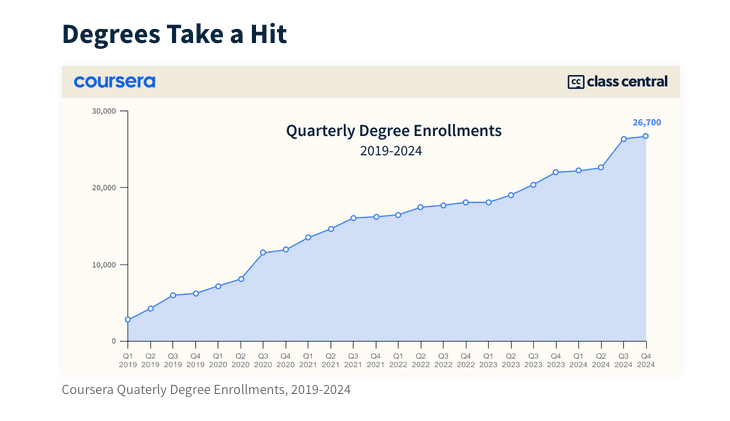
Recent data show that degree enrollments have plateaued and revenue per degree has declined. Coursera has increasingly shifted emphasis toward shorter credentials and enterprise offerings rather than continued degree expansion. This is the best-resourced version of the model. If scale were easy, it would be visible here.
The lesson is not that online degrees cannot succeed. It is that scale requires sustained marketing investment, institutional credibility, student support infrastructure, and retention strategies that go well beyond content delivery.
The proposed Khan TED Institute would enter a more crowded and mature market than Coursera did in 2017. It would do so without an existing institutional brand, and with an undergraduate target population that is typically more brand-sensitive and retention-challenged than graduate learners. A $10,000 price point is rhetorically powerful. But price alone does not solve acquisition costs, persistence challenges, or the economics of sustained student support.
What makes this different from earlier Khan Academy expansions is that the degree market is not a philanthropic distribution problem. It is a competitive acquisition problem. In the past, Khan Academy and Khanmigo benefited from large institutional adoptions, foundation support, and government partnerships. They did not have to fight for individual tuition-paying undergraduates in a saturated, brand-sensitive market with high marketing costs and low retention margins.
Competing in the undergraduate degree market requires sustained marketing investment, enrollment operations, student support infrastructure, and regulatory compliance — not simply compelling rhetoric and strong corporate brand associations.
Scale is not frictionless
The proposed curriculum for the new Khan TED Institute is fairly predictable and not unreasonable, if a bit STEM and jargon heavy.
*Core knowledge in mathematics, statistics, economics, computer science, science, history, and writing.
*Applied AI skills, including AI‑assisted app development, financial modeling, building AI agents, and team‑based deployment projects.
*Communication and leadership, developed through structured collaboration, peer tutoring, dialogue sessions, and public speaking"
On paper, this looks coherent. It blends some liberal arts with technical fluency, and applied collaboration. But what is striking is how frictionless the model sounds.
Content can be delivered asynchronously. Skills can be practiced in simulations. Dialogue sessions can be scheduled. But learning — especially for under-prepared or time-constrained students — is not a smooth pipeline from exposure to mastery. Learning requires feedback loops, accountability, structured practice, and often sustained human intervention. AI can assist with parts of this. It does not replace the systems and practices that make engagement durable.
If a voluntary tutoring tool struggled to move beyond a small, self-motivated minority, it is reasonable to ask what mechanisms will ensure persistence in a largely asynchronous degree, especially when the underlying logic still seems to be that access to a tool or content is enough and that students themselves bear responsibility for engagement.
This fact comes out in the recent Chalkbeat article from Sal Khan.
Khan gives this analogy: Imagine he walked into a class, sat in the back of the room, and waited for students to seek out help. “Some will; most won’t,” he said. That’s been the experience with AI tutoring, he said. It doesn’t necessarily make students motivated to learn or fill in gaps in knowledge needed to ask questions.
And from Kristen DiCerbo the Chief Learning Officer.
Kristen DiCerbo, the organization’s chief learning officer, said AI can only respond to students based on what they ask. And it turns out, she said, “Students aren’t great at asking questions well.”
And yet the need for deliberate and designed engagement is even more important in an online degree than in a tutoring app. The students most drawn to low-cost, asynchronous degrees are often balancing work, care-giving, and uneven academic preparation. Designing for their success requires more than access to content and AI tools. It requires structured support systems, good pedagogy and instructional design, integration into institutional processes, and sustained human accountability. And nothing in the current framing suggests that these structural engagement challenges are being treated as primary design requirements rather than downstream engineering problems.
The interval is shrinking
The debate over Khanmigo also prompted a sharp observation from one of the most perceptive critics of technology-mediated learning at scale. Before the announcement of the Khan TED Institute, Justin Reich proposed what he called the “time-to-TED-talk-renunciation” metric — the interval between a bold claim about technological transformation and the subsequent retreat to a more modest position.
In 2011, Khan argued "Let's Use Video to Reinvent Education." In 2019, he gave an interview with District Administration magazine where he suggested that actually we shouldn't reinvent learning, but students in math class should do online practice problems one day a week [snip] In 2023, Khan argued that "AI Could Save Education," and in 2026 Matt Barnum in Chalkbeat basically got him to quote the thesis of Failure to Disrupt: "“AI is going to help, but I think our biggest lever is really investing in the human systems.” [snip]
It begs the question, given that the time-to-TED-talk-renunciation is shrinking, at what point should we predict that Sal Khan gives a TED talk where he SIMULTANEOUSLY advances and then renunciates some techno-utopian idea
Reich’s framing is humorous. But it captures something real. Each new technological promise arrives with expansive rhetoric. Then implementation collides with student behavior, institutional inertia, and economic reality. The recalibration follows.
Reich even sketched a trend line.
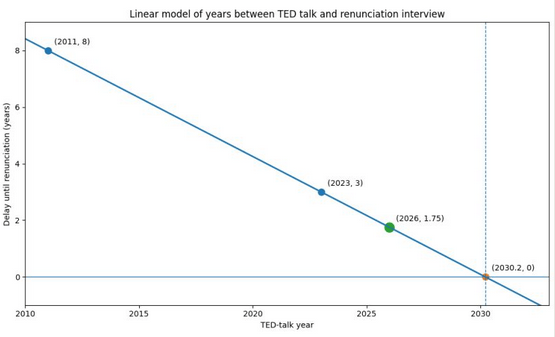
The interval appears to be shrinking.
And then, within days of Reich posting that chart, Sal Khan announced the Khan TED Institute — from the stage of a TED talk.
The humor works because the pattern is familiar. But the stakes are not trivial. Each cycle absorbs institutional attention, philanthropic dollars, public imagination — and some students who will enroll in the new experiment and struggle.
The deeper issue is not ambition. It is repetition. We keep repackaging familiar models without grappling with the structural constraints that limited them in the first place. In this case, that constraint is engagement — how to design for sustained participation among students who are balancing work, caregiving, uneven preparation, and financial risk.
The interval between declaration and re-calibration may be shrinking. The underlying mistakes remain unchanged — and they will produce the same outcomes unless the design logic changes.
If this was helpful or interesting to you, forward this post to others who may be interested. All we ask is attribution.
Thanks for being a subscriber.