- On Student Success
- Posts
- This Week in Student Success
This Week in Student Success
Student success and the things we don't see

Glenda Morgan
March 17, 2026

Was this forwarded to you by a friend? Sign up for the On Student Success newsletter and get your own copy of the news that matters sent to your inbox every week.
Happy St. Patrick’s Day! May your bacon and cabbage be delicious.
What is new in student success? A theme ran through several of the things I read this week: how easy it is to talk about student success while quietly ignoring the structural forces shaping student outcomes.
When “college quality” really means “student wealth”
Scrolling through LinkedIn this weekend, a trenchant comment on a post by the American Enterprise Institute’s (AEI) Preston Cooper caught my eye.

It turns out that this was hardly the spiciest comment on the post. Although DRTC (Don’t Read the Comments) is generally great advice, in this case I encourage you—in fact—to go read the comments. Do not pass go, do not collect $200. Go read the comments.
But what caused all this criticism and spicy consternation? Preston Cooper’s post, on the surface, seems perfectly reasonable and something that we, as proponents of student success, would favor.
He used the post to reiterate arguments he had made previously: that enrollment declines at what he calls “low quality” institutions were a market correction. But in this post he laments the fact that they are showing signs of a rebound.
He starts off with the correction.
Between 2010 and 2023, the number of students seeking degrees at the worst tranche of colleges dropped by nearly half, while student numbers at the best schools actually increased.
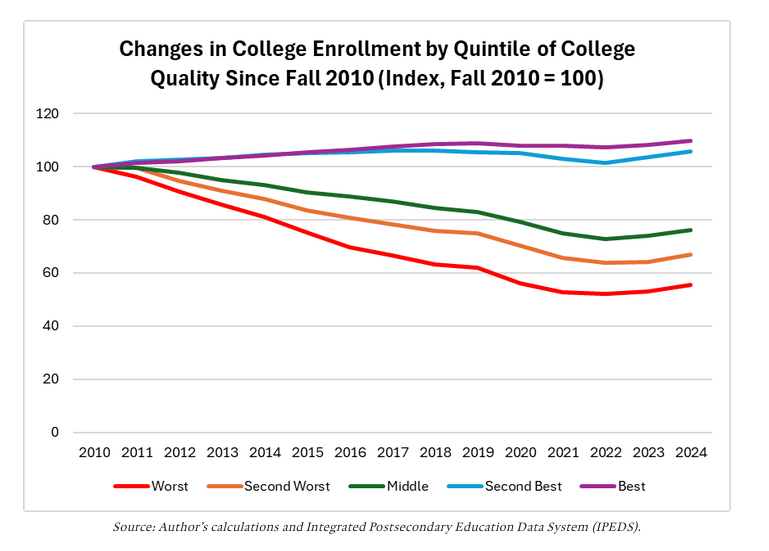
And then laments the fact that enrollments at “low quality” institutions are growing again
Enrollment at the worst fifth of institutions reached a nadir in fall 2022. Since then, student numbers at the lowest-quality schools have risen by over 120,000. The University of Phoenix, a for-profit megaschool in the bottom quintile of student outcomes, added nearly 19,000 degree-seeking undergraduates between 2022 and 2024. Enrollment grew at high-quality institutions as well, reflecting a broader rebound in college enrollment, but the rise at lower-quality institutions remains concerning.
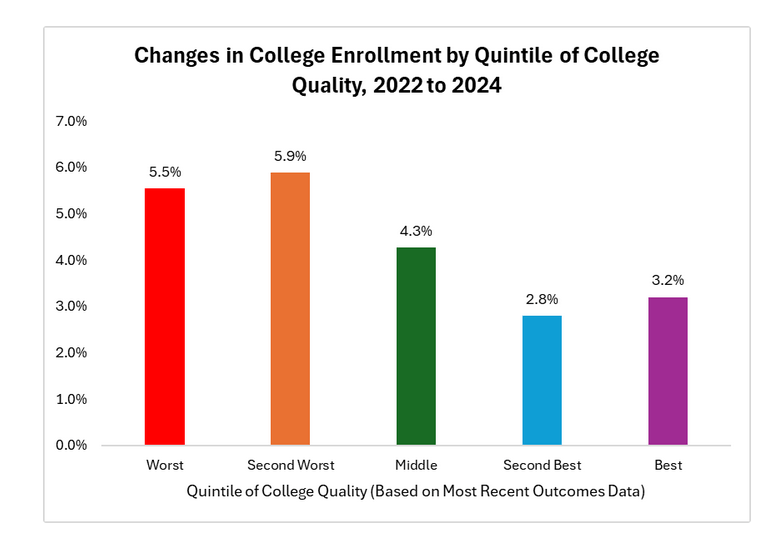
Cooper defines quality in terms of a composite index made up of four factors: the share of students who complete within 150 percent of normal time, the rate at which borrowers pay down principal, the loan default rate, and former students’ median earnings after leaving school. He weights each factor equally. At first glance, this seems like a reasonable way to define institutional quality. And who could possibly be opposed to quality? But the measures Cooper uses are not really measures of institutional quality at all. They are mostly measures of who institutions enroll.
The measures have little to say about the quality of education students receive. Not only are they more about who institutions enroll, but they are also strongly indexed to economic factors, making them even more reflective of the conditions shaping students’ lives before they enter college and after they leave.
Let’s look again at the four variables he uses: completion rate, loan repayment rate, loan default rate, and earnings. Each of these is strongly correlated with who the students are. For example, completion rates are heavily affected by:
part-time enrollment
transfer behavior
adult learners
academic preparation
Community colleges therefore appear “low quality” not because they fail their mission but because they serve students whose educational pathways often include part-time enrollment, transfer, and stop-outs—patterns that the metric treats as failure.
Loan repayment and default rates depend heavily on:
family income
student debt levels
post-college earnings
Institutions serving low-income students will almost always have worse repayment metrics, even if the institution is performing well.
Earnings are strongly influenced by:
major
regional labor markets
student demographics
occupational sorting
A nursing program will always produce higher earnings than early childhood education, regardless of institutional quality.
What Cooper’s index largely measures is not institutional quality but the socioeconomic composition of the student body. Institutions that enroll wealthier, better-prepared students will almost always look “high quality” by these metrics, regardless of what actually happens inside the classroom.
Hence Kemi Jonas’s comment.
But wait, it gets worse
Even though Preston Cooper’s argument is flawed and revealing, and was rightly roasted by the commenters, it is nevertheless an example of two related things I see far too often in EdTech and student success research and commentary.
The first is the simple ignoring of externalities. In the student success and online learning literature that I follow most closely, I repeatedly see research or analysis that does not acknowledge several basic realities:
Some students are far less well prepared than others because they attended less well-resourced schools.
Many of these same students have far less to draw on in terms of family wealth and social networks.
Some students have to attend part-time, work, and take care of family while attending college or university.
And the kinds of returns students receive from their educations are heavily shaped by gender, race, and whether they enter the workforce in a high-cost-of-living area or a region where wages are lower.
Instead, student outcomes are often treated as a function simply of whether the institution was “low” or “high” quality, or of the sector or modality of instruction.
Should we hold institutions to account for poor outcomes? Absolutely. I do that frequently in this newsletter, and I try to highlight and broadcast other research and analysis that does the same. But if that analysis does not take externalities into account, it is not being honest—either with itself or with its readers.
A second and related tendency I see is what I refer to as the “caveat-and-proceed maneuver.” Analysts and researchers acknowledge a limitation, signal methodological awareness, and then continue as if the limitation does not materially affect the conclusion.
In Cooper’s original post he acknowledges that student preparedness may play a role. The emphasis is mine.
Some of this is likely due to the characteristics of the students they enroll. Open-enrollment colleges in the bottom quintile probably enroll students with worse grades in high school, who struggle to pass their college courses and graduate on time.
This is a very small and rote admission. But he waves off even this fleeting and partial acknowledgement.
But much of the disparity in outcomes is likely due to institutional quality. Some colleges do better by their students than others.
Admitting that important factors are being left out and then using that admission as a get-out-of-jail-free card to ignore those factors while drawing bold and sweeping conclusions has become far too common in student success, online learning, and EdTech research.
These two tendencies are insidious, and should be called out every time.
A reminder to widen the lens
Related to this larger point, I was reminded recently of the need to check our assumptions.
I grew up in a pretty lower–lower-middle-class household; neither of my parents attended school beyond the age of 14. So I think of myself as fairly attuned to noticing economic and class assumptions in higher education. But a recent conversation with a friend and her husband has made me rethink that.
She and her husband both grew up in trailer parks in different parts of the Midwest, and over coffee with me recently they started talking about how there were always a couple of teachers in each school who “didn’t like poor kids.”
I asked what this meant, and they said that, for example, if you missed a day and asked the teacher if there was work to catch up on, the teachers who didn’t like poor kids would answer no. But there was indeed work, and so you would get a zero on that assignment.
Both of them ended up going to college and working in higher education. But I was shaken by this story.
Stories like this are a reminder that the forces shaping educational outcomes begin long before students arrive on campus. They are also a reminder to all of us that we need to constantly widen the lens through which we look at these issues.
The five unwritten rules of student success product names
After all that seriousness, let’s take a brief detour into something much lighter. Normally, by this point in the newsletter I’ve covered so many serious—and honestly often depressing—topics that I like to include a palate-cleansing funny post. Today, in that slot, I want to talk about student success product names.
I spend a lot of time these days looking at student success tools (and there are a lot of them). I’ve noticed that they tend to follow five key—but unwritten—rules when it comes to naming. I’ve left out actual examples, but I’m sure you can all think of some.
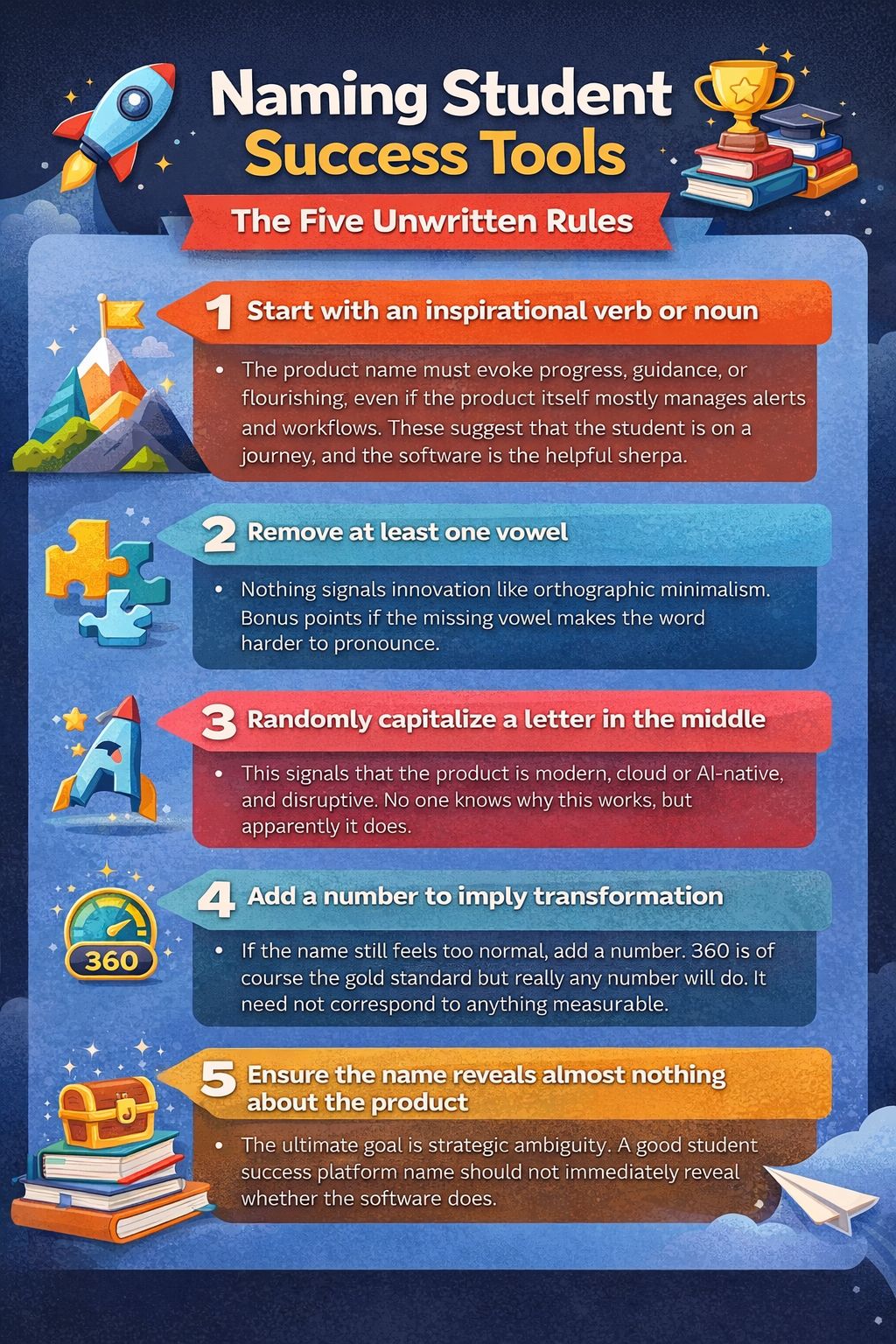
This is all meant in fun. I feel vendors’ pain in trying to come up with a name that hasn’t already been snagged and that will resonate with the intended audience.
Belonging vs connectedness
One place where the structural nature of student success shows up very clearly is in students’ social lives. A new survey by the College Student Mental Wellness Advocacy Coalition and the Hi, How Are You Project, highlights the importance of belonging, but the more striking signal may actually be connectedness. Thriving students report dramatically higher levels of social interaction with friends and family (81% vs. 34%), suggesting that belonging may be less a psychological state and more the result of being embedded in real social networks.
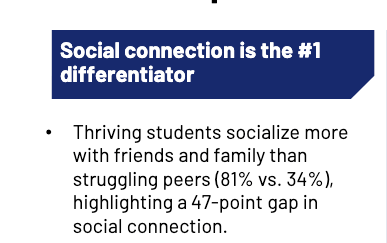
The report also reveals a large gap between awareness and help-seeking. Students overwhelmingly recognize the importance of mental health and know where to find support, yet roughly four in ten say they are uncomfortable discussing it, and nearly half fear being judged for doing so. The barrier appears to be social rather than informational.
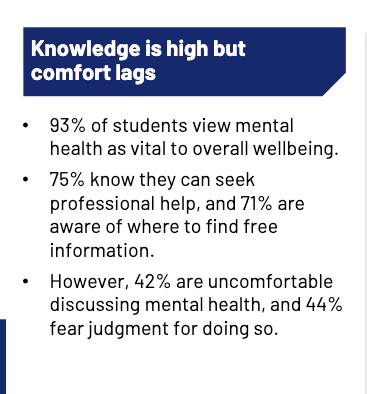
That pattern shows up across many areas of student success. Students often avoid tutoring, advising, and other support services not because they do not know about them, but because using them signals struggle and invites stigma. If that is the case, the challenge may not simply be expanding services but normalizing help-seeking behavior.
When student success disappears from the conversation
And maybe we also need to normalize college and university presidents thinking about student success. The new Inside Higher Ed 2026 Survey of College and University Presidents is out, and it is well worth a read. But something that struck me is how oddly absent the concept of student success is. Presidents talk at length about demographic pressures, enrollment challenges, changes to DEI, institutional finances, public perceptions of higher education, and the potential of AI.
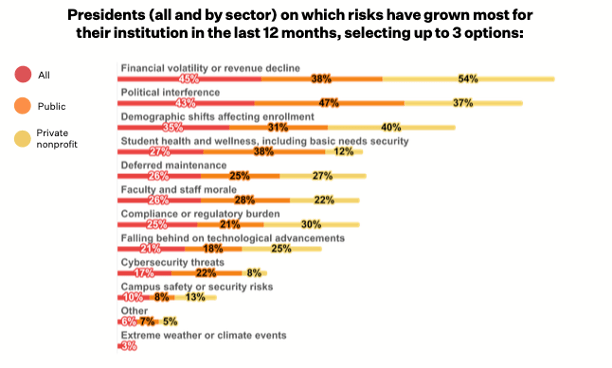
But student success itself—retention, progression, completion—rarely appears as a central concern. This is striking because many of the issues presidents highlight are tightly connected to whether students succeed once they enroll. Financial health, enrollment stability, and public confidence in higher education all depend, in part, on student outcomes. Student success shows up only indirectly—in discussions of AI tools that might support learning or in concerns about student wellbeing—but it is rarely framed as the underlying issue tying many of these concerns together.
In other words, we spend a lot of time talking about student success in higher education. But when leaders talk about institutional risk, student success itself often disappears from the conversation.
Taken together, these pieces highlight a recurring problem in higher education discourse. We talk about student success constantly, but we often define it using measures that obscure the structural realities students face, the social networks that support them, and the institutional practices that actually shape outcomes.
Until we grapple with those underlying forces, much of the student success conversation risks becoming a debate about metrics rather than about students.
Musical coda
In honor of St Patrick’s day, some Sharon Shannon, of whom I am a giant fan. The Galway Girl.
Also in honor of St. Patrick’s Day, imagine this newsletter is a snake and your job is to drive it out of Ireland.
Or at least out of your inbox, and into the inboxes of anyone who might enjoy it.
Thanks for being a subscriber.