- On Student Success
- Posts
- This Week in Student Success
This Week in Student Success
The short-term success trap

Glenda Morgan
March 31, 2026

Was this forwarded to you by a friend? Sign up for the On Student Success newsletter and get your own copy of the news that matters sent to your inbox every week.
This Very Good Boy turns 13 today.

But what happened this week in student success?
A number of things I read this week point to a similar underlying issue. Across very different domains—and in quite different ways—AI and workforce credentials, as well as career services and the use of adjuncts, reveal the same pattern: systems that optimize for short-term performance, efficiency, or provision rather than long-term learning, mobility, and effectiveness.
When performance isn’t learning
A new research report from Jason Lodge and Leslie Loble, part of the Australian Network for Quality Digital Education project, throws into stark relief the dangers of unwise AI use. Although the report is technically aimed at K–12 education, it is highly applicable to higher education. Lodge and Loble describe how AI, when used poorly, can undermine student learning.
This report investigates a profound new challenge driven by AI’s power to
rapidly access information and provide a semblance of thinking: the risk that
students will outsource too much of the cognitive work that is crucial to
establishing the knowledge, skill and ‘thinking infrastructure’ that enables both
schooling success and lifelong capacity for ongoing learning, understanding,
reflection, creativity and achievement.
This outsourcing of knowledge, or cognitive offloading, is increasingly being identified as a risk in the use of AI in learning, but this report advances our understanding of the issue.
The authors usefully distinguish between beneficial offloading—where AI is used to help with something peripheral to a task (for example, checking grammar)—and detrimental offloading, “when a learner uses AI to bypass this intrinsic cognitive effort (the desirable difficulties) required to build long-term knowledge schemas.”
Their argument relies heavily on the idea of a performance paradox, which I think is central to the challenge AI poses to learning.
A growing body of empirical research provides clear evidence for a “performance
paradox”: AI can boost a student’s performance on an immediate task while simultaneously diminishing the durable learning that is the goal of
education [snip].
This is a key observation. AI can be used to improve short-term performance while harming long-term learning. A core problem in higher education—especially in conventional methods of assessment—is that we are optimized to measure and reward performance rather than learning. This problem predates AI, but AI exposes it and makes it something we can no longer ignore. AI doesn’t create this problem. It exposes it.
A second insight from the report is that one consequence of cognitive offloading is that students never fully engage with domain knowledge. The authors usefully push back against the idea that skills like critical thinking can be decoupled from domain knowledge.
Insights from cognitive science, however, challenge this assumption [that you can divorce critical thinking from domain knowledge]. The evidence overwhelmingly
indicates that high-order skills, particularly critical thinking, are not generic [snip]. Instead, they are commonly deeply intertwined with and dependent upon a well-
organised foundation of domain-specific knowledge stored in long-term memory. As Willingham [snip] argues, “Thought processes are intertwined with
what is being thought about.” It is not possible to engage in critical thinking when one has nothing to think critically about.
They further argue that in the absence of domain knowledge, problems arising from cognitive offloading such as the performance paradox become that much worse.
The cognitive risks identified in this report (the performance paradox, [snip]) are not distributed equally. The research is clear that these negative impacts disproportionately affect novices; those who lack the very domain knowledge needed to critically evaluate the output of AI systems [snip].
This is a compelling argument against the claim—sometimes made (and which I won’t link to)—that the best use of AI is in teaching Gen Ed courses.
Finally, their identification of the real “cheating” risk is spot on. The issue is not AI doing the homework, but cognitive offloading itself—something far more difficult to detect and address.
The true educational risk of AI is not simply that students will use it to cheat on an essay. The far more profound risk is that AI may fundamentally
interfere with the cognitive processes of knowledge construction and verification, the very processes that build the long term memory stores and subsequent skills upon which the majority of critical thinking depends.
Early wins, long-term tradeoffs
An important report from the Fordham Institute examines the impact of industry credentials earned by high school students in Ohio. These credentials have grown immensely in popularity in recent years.
Like many other states, Ohio has experienced extremely rapid growth in credential attainment over the past decade, with the number of unique earners increasing nearly threefold between 2015 and 2023. In addition to an increase in credential earners, the total number of credentials offered in the state has ballooned to nearly 700 unique credentials offered in the 2025–26 school year

In the report, the author examines the longer-term effects—seven years after high school—of earning an industry credential, drawing on data from 1.3 million students who entered high school in Ohio between 2011–12 and 2019–20.
The top-line findings are striking.
Students who earn industry credentials are more likely to finish high school (87% versus 81%) but far less likely to enroll in formal post-secondary education (40.6% versus 49.3%).
Credential earners also earn substantially more—about 21%—than non-credential earners immediately after high school, but this advantage fades over time. By their mid-twenties (seven years after graduation), the premium has shrunk to just 5%. As the report notes, this points to a very short-term benefit.
The diminishing return may be partly due to students (without credentials) earning
college degrees, which helps their wages catch up. It’s also possible that some credentials help young people get their foot in the employment door but don’t help them climb the ladder after that.
Not all credentials are created equal. There are vast differences in the wage return of credentials in different sectors.
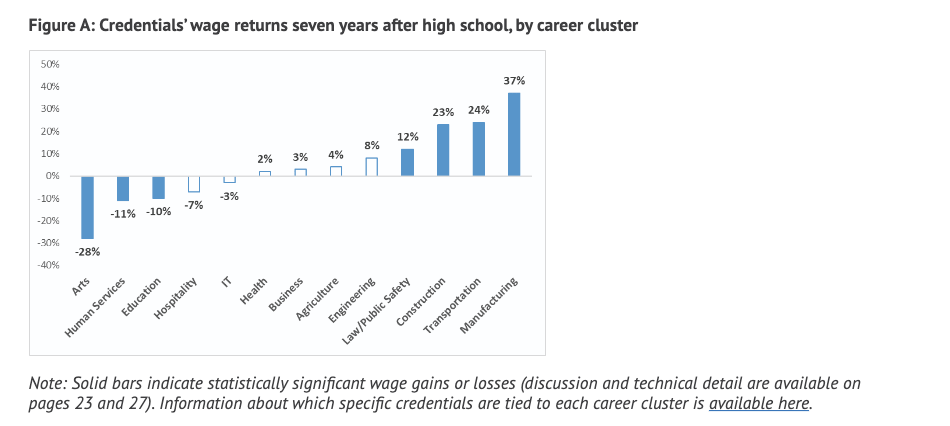
The wage gains not only depend on sectors, but are highly dependent on gender as well, though this is likely a function of the sector in which the credential was obtained.
By their mid-twenties, male credential-earners have annual incomes
23 percent higher than students who have not earned credentials, while female credential-earners enjoy no wage advantage at all (their returns are actually negative). This reflects the fact that males attain far more of the high-value credentials in such industries as construction, manufacturing, and transportation.
Even setting aside those gender differences, the data point to the risks of focusing too heavily on getting students into jobs and optimizing for earnings too early. Short-term gains may be short-lived. We are systematically steering students toward decisions that look successful early—and may limit their long-term options. These credentials are less about building pathways than replacing them.
The research also leaves a number of questions unanswered. The finding that earning a high school credential is associated with lower college or university attendance is critical. But it remains an argument about correlation. The author controls for demographics, prior achievement, and course-taking patterns, comparing students within the same schools and cohorts.
Students who pursue credentials may have always been less interested in—and less likely to attend—college, and the author explicitly acknowledges this. He also suggests that credential pathways themselves may “nudge” students toward immediate work, but stops short of unpacking what that might mean or how it operates. Even here, we see the same issue: we are quick to interpret outcomes as effects when they may reflect underlying choices and structures. Students are responding rationally to the signals we give them. The problem is that those signals are often misaligned with long-term success.
Seen together, these examples point to a deeper pattern. We are not just measuring the wrong things—we are structuring systems around those measurements.
Is your university financially sustainable?
This is a bit of an inside joke, as it relies on some knowledge of what happened at the University of Dundee last year. I wrote about the report authored by Pamela Gillies, which dissected what happened there, over at On EdTech.
The interim head of the University of Dundee, along with two members of its governing body, resigned this week following the release of a damning report from an investigation led by Pamela Gillies into the causes of the university’s financial distress. The institution’s previous leader had already stepped down in December. The financial shortfalls had necessitated a government bailout and substantial staff layoffs to address the large deficit.
The report makes for fascinating, if grim, reading. I would strongly recommend it to anyone as obsessed with interested in university politics as I am. It outlines how, although there were some external stressors (such as declining international enrollments), the real cause of the problems lay in the university’s culture, including a lack of tolerance for dissent or differing opinions.
What stands out is not just the financial mismanagement, but the absence of challenge. Systems optimized for smooth operation and consensus often suppress the very signals that would reveal underlying problems.
dissent, or challenge was routinely ‘shut down’, particularly by the Principal [a sort of combined President/Provost role in Scottish universities] who, we understand did not welcome difficult conversations. This was reported in Schools, Senate and UEG. It was suggested that this hindered open and honest discussion about finances and other matters in these fora. Few dared to speak truth to power, [snip] Female members of staff in particular, reported being spoken over, sidelined or discussed in public as being obstructive if they attempted to be heard
[The report goes on to describe how:]
the Principal’s overbearing leadership style, behaviours and dislike of potentially awkward confrontations or questioning and the potential adverse impact these factors may have had upon individuals and the overall culture of engagement within the University
Against this backdrop, someone writing under the nom de plume Prof Serious has created a quiz to help people determine whether their institution is financially sustainable. We could probably come up with an equivalent scoring system for the U.S.—I’m open to suggestions.
Each of the attributes listed below has a threshold value. If the attribute is above the threshold it should be scored as 1 Dundee. 10 Dundees = 1 Full Peck. If your university scores 8 Dundees, or above, you should probably check your inbox for your redundancy notice – the terms will not be attractive.
Number of Professors who aspire to be a Head of Department.
(0, score 1 Dundee)[Snip]
Number of overseas applicants for newly-launched ‘AI & Social Influencing’ (TikTok Studies) programme.
(Less than half the number in the business model, score 1 Dundee)Number of fields in the Academic Workload Allocation Model
(100, the point at which the model is no longer allocating workload but generating it, score 1 Dundee)Scale of inflated ambition in the India TNE business case.
(Imperial, score 1 Dundee)Pallor of Chief Operating Officer (COO).
(Grey, score 1 Dundee)Attractiveness of Voluntary Severance offer.
(Attractive to anyone with options, score 1 Dundee)[Snip]
A design problem, not a motivation problem
Although students increasingly identify getting a job as a key goal, yet few of them use the career center.

Students want career outcomes, but they don’t use career services. That’s not a contradiction—it’s a design failure. We are offering support at the wrong time, in the wrong format, and often in the wrong place.
The systems we don’t talk about
A growing share of teaching in U.S. higher education is done by adjuncts. Much of this is wonderful: inspired instruction from people with a real passion for their subject, many of whom work in the field or bring a valuable real-world perspective to their teaching.
But it is also a real challenge. Many adjuncts are low-paid and must string together multiple teaching roles to make ends meet. They can be only loosely connected to the institution and, as a result, less likely to be integrated into student success structures and practices.
The proportion of adjuncts teaching students also varies significantly by institution type, as a new CUPA-HR report makes clear. Adjuncts teach at two-year institutions at nearly twice the rate as at doctoral institutions.
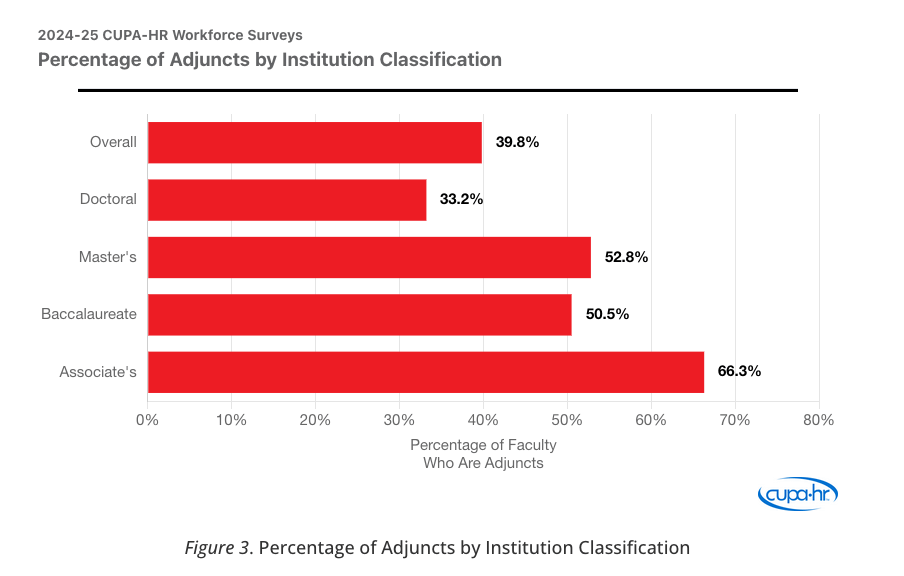
It also varies a great deal by topic. Most adjuncts are concentrated in the humanities, security/protective services, multidisciplinary studies and education.
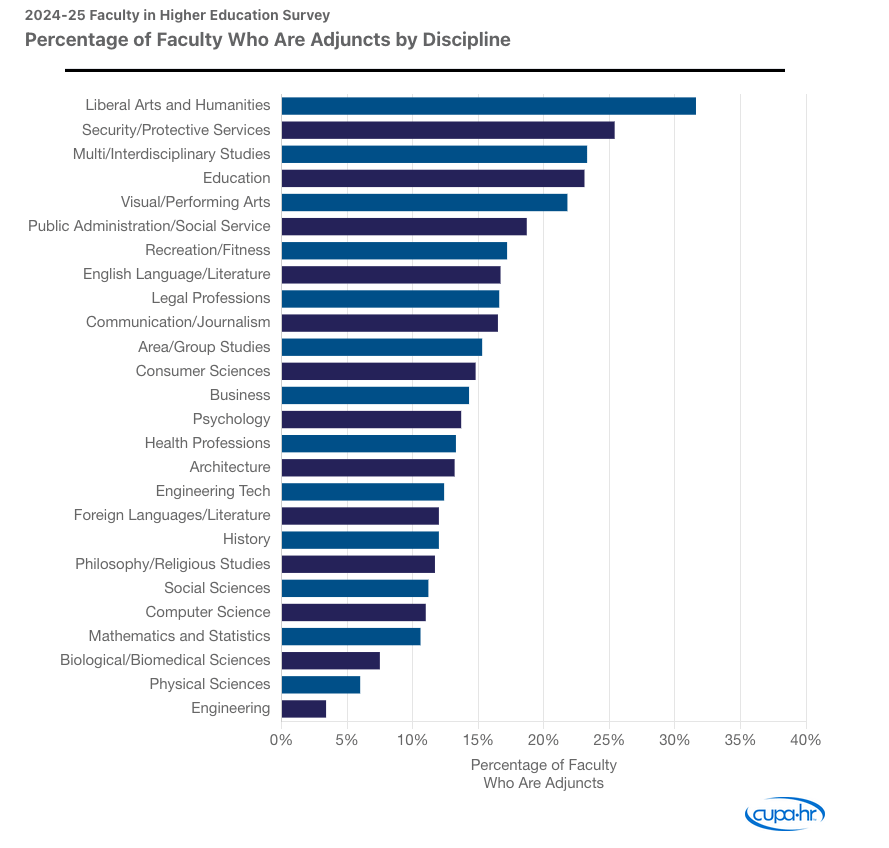
This both intensifies the need for—and complicates—the delivery of student supports in these institutions and in the areas they serve. We design student success systems as if institutions are stable, cohesive environments, when in reality large portions of instruction are delivered by people structurally disconnected from those systems.
Across all of these examples, the pattern is similar. We focus on what is easiest to measure—performance, early earnings, initial placement. But these are not the same as learning, long-term mobility, or meaningful outcomes. We are confusing what is visible now with what matters over time.
Musical coda
I love this video (and this song).
In keeping with this week’s theme, this post is optimized for short-term performance—specifically, how widely it gets forwarded. Please don’t disappoint.
Thanks for being a subscriber.